

Why Britain has a deer problem

NJ Convery

 BBC
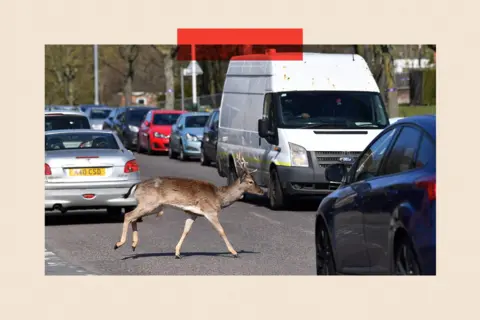
BBCBen Martill often gazes out of his window to watch the deer roaming below. “In the past few years there have been loads of them,” he says. Yet Ben doesn’t live in rural woodland but in a block of flats on a fairly busy road in the market town of Horsham in West Sussex. He often sees deer on the main thoroughfares.
Listen to NJ reading this story
“There are herds running up Crawley Road,” he says. “Loads congregate at night on the traffic island of the bypass.”
Ben, 33, is a gardener, and some of his customers have had deer break down their fences and strip the bark from the trees. He’s had a near miss in his car, too.
“I clipped one, poor thing. It darted off into the bushes.”
These sorts of scenes have become increasingly common – and that comes with serious economic, social and environmental costs.
Deer numbers have rocketed over the last 40 years but since the Covid-19 pandemic, when culling dropped significantly, many deer experts like Jonathan Spencer, a former head of planning and environment at Forest Enterprise (now Forestry England), say the numbers have got completely out of hand.
 AFP via Getty Images
No-one knows exactly how many there are but the Forestry Commission and the Department for Food, Environment and Rural Affairs (Defra) suggest there may be two million in Britain – a huge increase from the estimated 450,000 in the 1970s, according to the Forestry Commission.
Their impact is being widely felt, with the rising numbers leading to problems for drivers, farmers and businesses as well as wildlife and the countryside’s natural landscapes.
While there are no recent official estimates of the total cost to the UK of damage caused by deer, it’s clear that it is substantial. In 2021, Forestry and Land Scotland estimated the cost of the damage caused by deer just to young trees in Scotland’s national forests and land at £3m a year.
Lucy Manthorpe runs a 400-acre organic arable farm in Suffolk and says she was losing over £10,000 worth of crops a year to deer damage on three fields. To solve it, she has employed a full-time worker whose main job is culling deer.
The deer problem is “costing us as a country,” she argues.
Farmers and landowners can see losses easily run into the tens of thousands, according to the Forestry Commission, and some with high-value crops can see losses of as much as £1m in a year.
Tackling rising deer numbers is now seen as a priority by conservationists, farmers and the government alike – in 2022 Defra admitted: “We need to do more to sustainably manage deer.”
The real problem emerges when it comes to deciding how to do that – with some more radical-sounding approaches pioneered overseas, including reintroducing wolves to the landscape. The Countryside Alliance, however, says this would be “disastrous”.
From car crashes to trampled crops
There are few places in the world better suited to deer than modern Britain with its mild climate, open countryside, no animal apex predators and few human hunters.
An estimated 350,000 deer are removed from the British landscape annually via hunting and culling, according to the Country Food Trust, but the overall population is still rising – in 2023 parliament was told that up to 750,000 deer a year may need to be culled to keep the population stable.
The place where many of us have our closest encounter with a deer is when one of them meets the front of our car. The number of deer killed or injured on UK roads each year could be as high as 74,000, says the AA, leading to hundreds of human injuries and in some cases, fatalities. In October this year a 63-year-old motorcyclist in Oxfordshire died after hitting a deer, an inquest was told.
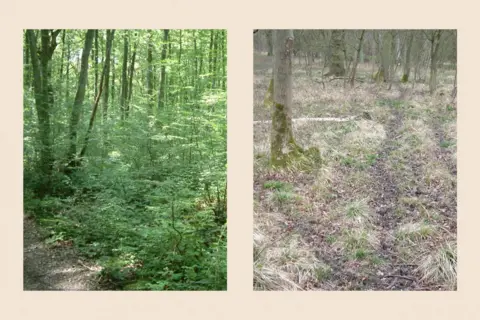
Then there is the impact on woodland. Natural regrowth of trees is almost impossible in areas of high deer density as they eat any fresh shoots which appear, says Alison Field, president of the Royal Forestry Society.
“The pressure of the deer now has become so great that we’ve lost the balance out of our landscape.”
 Forestry Commission
As far back as 2013, an academic study published in the Journal of Wildlife Management by University of East Anglia researchers suggested that around half of the UK’s growing deer population needs to be shot each year to stop devastation of woodlands and birdlife.
Some people’s gardens have also been affected by deer munching their flora. Large herds of fallow deer cause problems for arable farmers throughout the year, too, trampling freshly planted crops in the spring and then returning to nibble their way through the fields ahead of harvest time.
Why deer numbers grew and grew
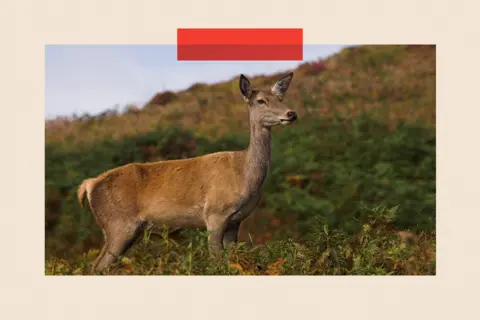
There have been deer in mainland Britain for thousands of years but only two of the now six species that live here are natives, namely red and roe deer. Fallow deer were first introduced by the Romans in small numbers, and the species expanded under the Normans when owning a deer park was a must-have for any self-respecting nobleman.
“A few centuries ago deer were the property of a privileged few in deer parks, royal forests and chases,” says Mr Spencer.
Three other Asiatic species – sika, Chinese water deer and muntjac – all arrived in the late 19th Century.
Mr Spencer explains how after the end of World War One, many grand estates fell into disrepair. In turn, park boundaries collapsed and the deer simply walked out.
It took a long time for numbers to reach their current level.
The 1963 Deer Act introduced restrictions on culling deer and the seasons during which that can happen. By the 1990s, deer had spread so widely that the gaps between separate populations had filled, explains Mr Spencer.
He suggests that the decreasing numbers of people who may previously have taken the odd deer for their dinner table is also a factor.
An added complication is that technically no-one owns Britain’s deer. The law deems them res nullius, which literally means a thing belonging to nobody – so responsibility falls to individual landowners.
Bears, lynx and wolves
Bringing deer numbers under control could benefit farmers, the environment and communities across the country – but achieving a consensus on how to do that is not straightforward.
Some animal rights organisations that oppose deer hunting instead advocate non-lethal methods of management, including darting deer with contraceptives, or building more or better fencing.
However, groups including the British Deer Society (BDS), a charity that promotes sustainable deer management, consider these methods to be challenging to implement at scale as the person firing the dart has to get much closer than someone firing a rifle.
Fencing can be effective but comes with significant costs, requires ongoing maintenance and also has the unintended consequence of excluding other wildlife from woodlands, the BDS says.
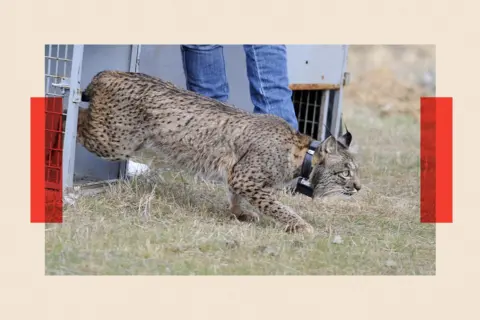
Some big rewilding projects – especially those in more remote parts of Scotland, where the majority of red deer in Britain live, according to the Woodland Trust – talk about another, even more dramatic option: the reintroduction of apex predators, and in particular lynx, wolves and perhaps even brown bear, all of which were once found across Britain, to control deer numbers.
 AFP via Getty Images
The environmental campaigner and writer George Monbiot has said wolves and lynx could be relied on to “get on with the job”. Trees for Life, which has a 10,000-acre rewilding estate in the Scottish Highlands, says: “Lynx could bring a wide range of ecological and societal benefits to Scotland.”
In many parts of mainland Europe, including Italy, Switzerland, and France, lynx and wolves have returned to landscapes over the past 30 years. In 1995, wolves were reintroduced to Yellowstone National Park in the United States to help manage the park’s population of Rocky Mountain elk (similar to the red deer) – this was followed by the recovery of forests.
Dr Mike Daniel, who runs a Sustainable Deer Management course at the University of the Highlands and Islands in Perth, says: “Ecologically, wolves and lynx could thrive in the UK.” But such plans would face likely opposition from farmers, landowners and local communities.
Countryside Alliance chief executive Tim Bonner says reintroducing wolves would “bring misery for livestock farmers”. While it might be possible to reintroduce lynx, he says, “lynx predation could only ever be a small part of the annual cull required to keep numbers in check”.
And Dr Daniel agrees that it would be difficult to have wolves and lynx co-exist alongside farms and estates: “Being honest, it’s not a panacea,” he says.
A natural resource?
Jonathan Spencer suggests that more radical measures may be required, to ensure long-lasting biodiversity improvements.
“There has to be a lot more recognition of the scale of the problem and some rather hard-hearted approaches like rounding up the deer and shooting them in an enclosure,” he argues. “That would go down like a lead brick socially”.
The Deer Act 1991 gives protections to wild deer but allows landowners or those with their permission to kill or take deer. Shooting seasons also restrict when some types of deer can be hunted, and there are strict rules around the type of rifles and ammunition that can be used to hunt them.
Culling significantly more deer also raises the question of what to do with the carcasses.
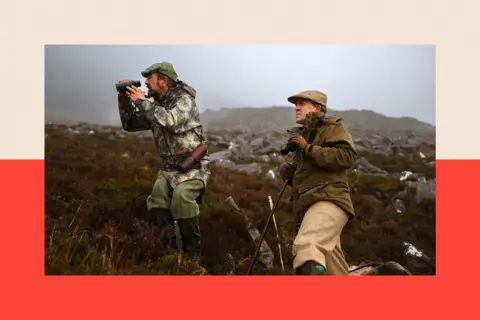
There is widespread agreement among some of the experts I’ve spoken to that eating more venison is an attractive option. “From a human point of view [deer] are a sustainable, natural resource,” argues Charles Smith-Jones, a technical adviser at the BDS.
 Getty Images
Venison is considered to be healthier than beef as it is lower in saturated fat and higher in various nutrients.
What’s more, wild venison – or deer meat that has not been farmed – is also believed to be better for the environment as it has lower associated carbon emissions than farmed meat. (Mr Spencer warns against eating roadkill however, which could be a health risk.)
While there are professional cullers, such as Forestry Commission rangers who may shoot hundreds of deer a year, the BDS says 70% of deer shot in Britain are shot by people who are not employed to do it.
But there is also the question of what is most humane – and best – for the animals. Elisa Allen, vice-president of People for the Ethical Treatment of Animals (Peta), says: “We don’t need to eat deer – and deer don’t wish to be eaten.” She calls instead for “humane, sustainable methods of population control”.
‘Nature is deciding’
Part of the problem is the fact that this is left up to individual landowners to resolve, resulting in inconsistencies. So, for example, measures taken by one landowner to manage deer on their property can be undone by a neighbour who decides not to do the same (as deer are pretty good at jumping walls and getting under fences).
The place where all these issues arguably come into starkest contrast is in Scotland, which is also home to Britain’s largest deer-stalking estates and rewilding projects.
A law to introduce new powers to tackle numbers in areas facing climate and biodiversity crises is currently passing through the Scottish Parliament.
Scottish Agriculture Minister Jim Fairlie says he wants to see “a voluntary partnership with land managers and deer management groups”.
In England, the government previously ran a consultation on deer management proposals, however its conclusions remain unpublished. A Defra spokesperson said: “There is a range of government support and grants available to help land managers manage these impacts, and we will be setting out further measures in due course.”
The Welsh government says it is looking at ways to take forward its Wild Deer Management strategy, published in 2021.
 Universal Images Group via Getty Images
Many of the same problems are faced across the island of Ireland where deer numbers have also risen significantly. Northern Ireland’s Department of Agriculture, Environment and Rural Affairs told us the impact of damage caused by deer is “reviewed on an annual basis”.
But while governments in all parts of the UK may face tougher decisions ahead if they really want to bring deer numbers under control, the example of Lucy Manthorpe’s farm shows the change that can be made to the landscape if the issue is tackled.
Since she hired staff to deal with it, areas that were barren ground have begun bursting with oxlips and early purple orchids. Rare trees are growing again too, she says.
The farm has also recorded significant increases in moths and breeding birds.
“The deer are not deciding what’s going to happen any more,” she tells me. “Nature is deciding.”
To picture credit: Anadolu via Getty Images

BBC InDepth is the home on the website and app for the best analysis, with fresh perspectives that challenge assumptions and deep reporting on the biggest issues of the day. You can now sign up for notifications that will alert you whenever an InDepth story is published – click here to find out how.
Source link
